3 Ways to Beat Burnout: A Therapist's Guide

Burnout is not a personal failing. It is not laziness, weakness, or a sign that you chose the wrong path. It is what happens when a caring, capable human being gives too much for too long - without enough coming back in return.

May 2026 7 min read
At Creative Resilience, we see burnout often. It arrives quietly at first - a creeping exhaustion, a growing sense of disconnection from work you once loved. By the time most people reach us, they have been pushing through it for months, wondering what is wrong with them. Nothing is wrong with you. Your nervous system is simply trying to tell you something important.
What burnout actually is - and what it isn't
Burnout is a state of chronic stress that leads to physical and emotional exhaustion, cynicism, and feelings of ineffectiveness. In 2019 the World Health Organization formally recognized it as an occupational phenomenon - but here's what the clinical definition doesn't always capture: burnout feels deeply personal.
It tends to show up across three dimensions. First, there is the exhaustion - a bone-deep tiredness that sleep alone cannot fix, emotional as much as physical. Then comes cynicism: a growing detachment from work you once found meaningful, a sense of going through the motions. And finally, inefficacy - the quiet, creeping belief that nothing you do matters, or that you are no longer capable of doing it well. Together, these three things can make you question your values, your relationships, and your sense of who you are.
Burnout is often confused with stress. The difference matters. Stress usually feels like too much - too many pressures, too many demands. Burnout feels like too little - too little energy, motivation, and hope. Stress can push us; burnout hollows us out.
The three types of burnout
Not all burnout looks the same. Psychologists Ayala Pines and Elliot Aronson identified three distinct types - and knowing which resonates with you can be a meaningful first step toward understanding what you actually need.

You may recognize yourself in more than one of these - that's very common. What matters is beginning to understand the particular shape your burnout has taken, because that shapes how you move through it.
The five stages of burnout
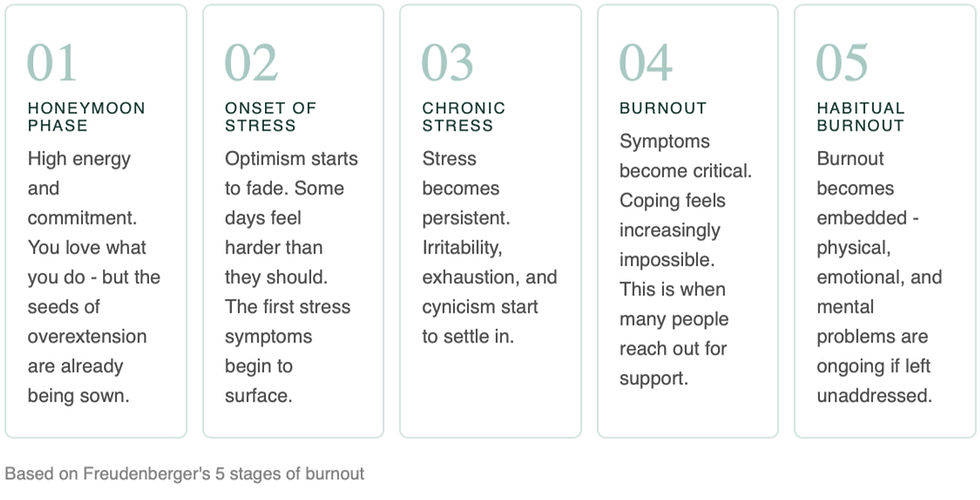
Burnout doesn't arrive all at once. Psychologist Herbert Freudenberger identified five distinct stages - and understanding where you are in that progression can be one of the most clarifying things you do for yourself.
You may recognize yourself in more than one of these - that's very common. What matters is beginning to understand the particular shape your burnout has taken, because that shapes how you move through it.
The five stages of burnout
Burnout doesn't arrive all at once. Psychologist Herbert Freudenberger identified five distinct stages - and understanding where you are in that progression can be one of the most clarifying things you do for yourself.

3 ways to start beating burnout
There is no single fix - but there are places to begin. These three approaches are ones we come back to again and again in our work at Creative Resilience, because they address the root rather than just the symptoms.
ONE
Learn to recognize your own warning signs
Burnout rarely announces itself clearly. More often, it sneaks in through the back door - disguised as irritability, or an inability to concentrate, or just a vague feeling that something isn't right. Building the habit of noticing is one of the most protective things you can do.
Dreading work you once looked forward to
Feeling numb or emotionally flat, even in moments that should feel meaningful
Withdrawing from colleagues, friends, or family
Difficulty concentrating or making decisions
A persistent inner critic telling you that you're not doing enough
You don't need to be ticking every box. Even two or three of these, persisting over weeks or months, is worth paying attention to.
TWO
Attend to your body, not just your mind
We tend to think of burnout as a mental experience, but your body carries it too. Chronic stress keeps your nervous system in a state of low-level alert - and over time, that takes a real physical toll.

Healing burnout means attending to the body - through sleep, movement, rest, and nervous system regulation - not just trying to think your way out of it.
THREE
Shift your relationship with rest and worth
Recovery from burnout isn't about a single weekend away. It requires something deeper: a shift in how you relate to yourself, your work, and what you believe you owe to others. For many people, burnout is rooted in the belief - often unconscious - that their worth is tied to their productivity.
At Creative Resilience, this is where our therapeutic work often begins. Understanding the patterns that led you here - the perfectionism, the difficulty saying no, the inability to ask for help - and slowly, gently, building a different relationship with yourself.

If any of this feels familiar, you don't have to navigate it alone. We're here when you're ready.
The journey starts with one step: seeking the support you deserve.
This blog is for informational purposes only and does not constitute clinical advice. Please speak to a qualified mental health professional for personalised support.


Comments