PTSD and CPTSD: Understanding Trauma and Finding Your Way Forward

Trauma changes the way the brain and body experience safety. If you are living with PTSD or CPTSD, you are not broken - your nervous system learned to protect you. This post explores what these conditions really are, how they differ, and what healing can look like.

May 2026 . 12 min read
Post-traumatic stress disorder (PTSD) and complex post-traumatic stress disorder (CPTSD) are two of the most misunderstood conditions in mental health. Many people associate PTSD only with combat veterans or survivors of single, dramatic events. But trauma is far broader than that - and the impact it leaves behind is deeply personal, often invisible, and almost always more nuanced than the stereotypes suggest.
Whether you have a diagnosis, suspect you might, or are simply trying to make sense of what happened to you, this post is a starting point. Not a checklist. Not a label. Just an honest look at what these experiences involve, and what support can genuinely offer.
What is PTSD?
PTSD is a psychological response to one or more traumatic events. It can develop after experiencing or witnessing something that felt life-threatening, overwhelming, or deeply violating - a car accident, a natural disaster, an assault, a medical emergency, or the sudden loss of someone close.
Not everyone who goes through a traumatic experience develops PTSD. Factors like prior trauma history, the presence or absence of support afterward, and individual neurobiology all play a role. This is not about strength or weakness. The nervous system simply has limits.
PTSD was formally recognized in the DSM-III in 1980, largely due to research on Vietnam War veterans - though clinicians had described similar presentations for decades under terms like "shell shock" and "combat fatigue." Today, we understand it to affect people across all demographics, backgrounds, and life experiences.
Common signs of PTSD
PTSD typically clusters around four broad symptom groups:
Intrusion - flashbacks, nightmares, intrusive memories, or distressing physical sensations that bring the trauma back into the present
Avoidance - steering clear of people, places, conversations, or feelings that remind you of what happened
Negative changes in thinking and mood - persistent guilt, shame, emotional numbness, difficulty experiencing positive emotions, or distorted beliefs about yourself or the world
Hyperarousal - being constantly on edge, difficulty sleeping, irritability, difficulty concentrating, exaggerated startle responses
What is CPTSD - and how is it different?
Complex PTSD (CPTSD) is distinct from PTSD, though the two share significant overlap. Where PTSD often follows a single traumatic event, CPTSD typically develops in response to prolonged, repeated trauma - particularly when that trauma occurred in a context where escape felt impossible.
This might include childhood abuse or neglect, domestic violence, prolonged captivity, trafficking, or growing up in an environment of chronic fear and unpredictability. The "complex" in CPTSD refers not to something being more complicated or more severe, but to a different pattern of difficulties that emerge when trauma is ongoing rather than acute.
CPTSD was officially recognized in the ICD-11 (the World Health Organization's classification system) in 2018. It is increasingly used in clinical settings and research as a distinct diagnosis.
Signs that may be specific to CPTSD
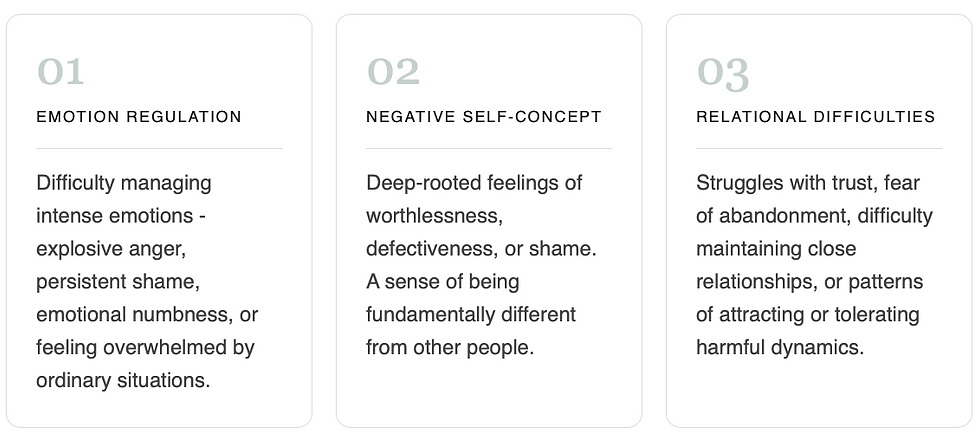
In addition to the symptoms of PTSD, people with CPTSD often experience difficulties in three additional areas - sometimes called "disturbances of self-organization":
Why trauma gets "stuck"
When something threatening happens, the brain's survival response activates instantly - flooding the body with adrenaline, sharpening attention, preparing for fight, flight, or freeze. This is a normal, healthy mechanism. The problem arises when the threat is over but the brain doesn't fully receive that signal.
Traumatic memories are often stored differently from ordinary memories. Rather than being integrated into narrative form - a story with a beginning, middle, and end - they remain fragmented, sensory, and vivid. A smell, a sound, a tone of voice can trigger the nervous system into acting as if the original threat is still present.
This is why trauma is not simply something you can "think your way out of." The response lives in the body. Healing, therefore, needs to reach the body too.
What does healing actually look like?
Healing from PTSD and CPTSD is not a straight line. It is rarely dramatic. Most of the time, it happens quietly - in the space between sessions, in the moments where an old trigger lands differently, in the gradual shift from reacting to responding.
Trauma-focused therapy typically works in phases. This phased approach is not about avoiding the hard material - it is about making sure you have enough internal resources before moving toward it. Processing trauma without adequate stabilization can be retraumatizing, which is why pacing matters enormously.

Evidence-based approaches commonly used in trauma therapy include EMDR (Eye Movement Desensitization and Reprocessing), trauma-focused CBT, somatic therapies, Internal Family Systems (IFS), and psychodynamic approaches. The right fit depends on the individual - their history, their nervous system, and what feels safe enough to begin with.

What to expect from therapy at Counselling Resilience
If you come to us with a trauma history - whether or not you carry a formal diagnosis - we will not rush you. We know that trust takes time, especially when the people or environments meant to keep you safe were the source of the harm.
Our therapists are trained in trauma-informed approaches and will work at a pace that feels manageable for you. The goal is not to re-live what happened. It is to help you build enough of a relationship with your own experience that it no longer controls you.
You do not need to have everything figured out before you reach out. You just need to be willing to begin.


Comments